
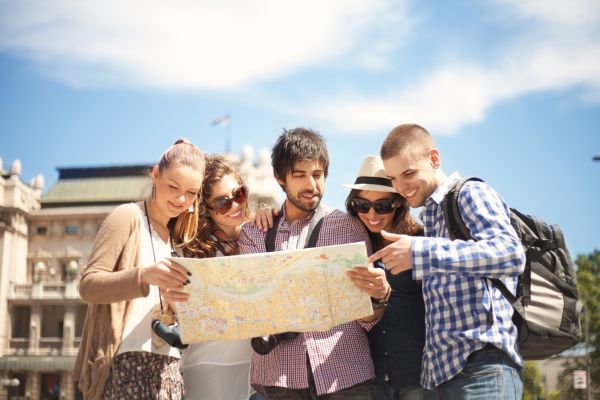
There is something quietly unsettling about traveling with strangers. You may share a train compartment, join a group tour, accept a ride from someone you have just met, or sit beside an unfamiliar person on a long flight. At first, the space between you feels formal. Everyone guards their bags, checks their phones, and avoids eye contact.
A delayed departure sparks a conversation. Someone offers a snack. A traveler asks for directions, and suddenly two people who knew nothing about each other are comparing hometowns, families, favorite foods, and the reasons they decided to leave home.
Traveling with strangers can feel unpredictable, but that uncertainty is also what makes it memorable. Away from familiar routines, people often become more open. Conversations happen faster, stories become more honest, and brief encounters can stay in the mind long after the journey ends.
The Curious Freedom of Being Unknown
At home, most people live inside established identities. They are known as a colleague, parent, neighbor, friend, or partner. Expectations follow them everywhere.
Travel creates distance from those roles. When speaking with someone who knows nothing about your background, you can introduce yourself without history attached. You are not required to explain every old decision or maintain the version of yourself that others expect to see.
That freedom can make conversations with strangers surprisingly personal. A person may speak openly about changing careers, ending a relationship, dealing with grief, or chasing a dream they have barely admitted to anyone else. There is a strange comfort in knowing that the listener may disappear from your life after the next station.
The conversation feels safe because it exists outside ordinary life. There may be no future judgment, no gossip, and no complicated social consequences. Just two people speaking honestly for a few hours.
Of course, not every encounter becomes meaningful. Sometimes traveling with strangers means enduring loud phone calls, awkward silence, or someone who takes over the armrest. Yet even these ordinary moments become part of the story.
How Shared Discomfort Brings People Together
Travel rarely goes exactly as planned. Flights are delayed. Buses break down. Weather changes suddenly. Reservations disappear. Luggage takes an unexpected trip of its own.
These inconveniences are frustrating, but they often create connection.
When everyone is dealing with the same problem, social barriers become less important. Strangers begin exchanging updates, sharing charging cables, watching each other’s bags, or making jokes about the situation. The person who seemed distant twenty minutes earlier may become an ally in the search for another route.
Shared discomfort creates a temporary community. People may not have chosen one another, but they are facing the same uncertainty. That alone can produce a sense of trust.
A long delay at an airport, for example, can turn a waiting area into a small neighborhood. One person finds information at the service desk. Another locates an open café. Someone else keeps an eye on the departure board. Without formally agreeing to work together, the group begins cooperating.
By the time the journey resumes, the delay may no longer feel like wasted time. It becomes the moment everyone remembers.
Stories That Only Exist for a Single Journey
Some travel friendships last for years. Others survive only until the bus reaches the final stop.
There is nothing disappointing about that.
Not every meaningful connection needs to become permanent. A brief conversation can still offer comfort, perspective, or a new way of seeing the world. The value of the encounter does not depend on exchanging phone numbers.
Perhaps an elderly passenger tells you about the town where she grew up. A student describes leaving home for the first time. A tired father shares why he travels every weekend to visit his children. These stories may never continue, but they add depth to a journey that might otherwise have been forgettable.
Traveling with strangers gives people access to lives they would rarely encounter in their normal social circles. Different ages, professions, cultures, and beliefs meet in the same carriage or hostel kitchen.
The meeting is accidental, yet the effect can be lasting.
Years later, you may forget the exact route, the seat number, or the name of the hotel. But you remember the person who made you laugh when everything went wrong. You remember the stranger who helped carry your suitcase up a broken escalator. You remember the conversation that made you reconsider a decision.
Some stories are complete precisely because they are brief.
The Difference Between Openness and Carelessness
The romantic side of traveling with strangers should not replace common sense. Connection is valuable, but personal safety still matters.
Trust should grow gradually. A friendly conversation does not require sharing private financial information, accommodation details, passwords, or a complete travel schedule. It is possible to be warm without becoming careless.
Public settings are usually the best place to interact with unfamiliar people. When joining someone for an activity, telling a trusted person where you are going can provide an extra layer of security. Paying attention to local customs, transportation rules, and personal boundaries is equally important.
Instinct also deserves respect. Travelers sometimes ignore discomfort because they do not want to appear rude. Yet leaving an uncomfortable conversation, changing seats, refusing a ride, or walking away from a situation is not impolite. It is sensible.
Healthy travel connections are based on mutual respect. A trustworthy person will not pressure you to reveal more than you want to share or push you into plans that feel unsafe.
The goal is not to fear every stranger. It is to remain aware while allowing room for genuine human contact.
When Strangers Become Travel Companions
Occasionally, a casual meeting develops into a shared journey. Two solo travelers discover that they are visiting the same city. Hostel guests decide to explore a market together. People on a walking tour make plans for dinner.
These spontaneous groups can make travel richer. Costs may be shared, unfamiliar places can feel less intimidating, and experiences become more enjoyable when there is someone beside you who is seeing everything for the first time too.
Still, traveling together requires flexibility. Strangers may have very different budgets, energy levels, interests, and ideas about time. One person wants to visit every museum. Another wants to sit in a café for three hours. Someone wakes before sunrise, while someone else considers noon an early start.
The best temporary travel companions communicate clearly. They do not assume that every meal, activity, or expense must be shared. They understand that spending time apart does not mean the friendship has failed.
In fact, space often protects the connection. A day of separate plans can make the next shared dinner more enjoyable.
What These Encounters Teach Us
Traveling with strangers reveals how quickly people can find common ground. Language, nationality, age, and background may shape an interaction, but they do not always prevent understanding.
People connect through simple things. Missing home. Feeling nervous. Being hungry. Laughing at a misunderstanding. Admiring the same view. Trying to pronounce the name of a local dish and getting it completely wrong.
These moments remind travelers that most human lives contain familiar emotions, even when the details are different.
Strangers can also challenge assumptions. A conversation may complicate what you thought you knew about a country, culture, profession, or generation. Personal stories often show more nuance than headlines or stereotypes ever could.
Travel does not automatically make everyone open-minded. But it creates opportunities. Whether those opportunities become meaningful depends on curiosity, patience, and the willingness to listen.
The Connections We Carry Home
The most powerful part of traveling with strangers is not always the friendship itself. Sometimes it is the version of ourselves that appears during the encounter.
We become more willing to ask questions. More comfortable admitting confusion. More likely to accept help and offer it in return. We remember that connection does not always require years of familiarity.
A stranger may enter the journey for ten minutes, one evening, or several days. They may become a lifelong friend, a name in an old notebook, or simply a face remembered from a rainy station.
Whatever happens, the encounter adds something to the road.
Traveling with strangers teaches us that the world is not made only of destinations. It is also made of unexpected conversations, temporary kindness, shared inconvenience, and stories exchanged between people who were never supposed to meet.
Sometimes the most memorable part of a journey is not where you went. It is who happened to be traveling beside you.